What Is Skin Education?

Direct Answer
Skin education is the systematic study of skin anatomy, behavior, and care methodologies. It focuses on how the skin functions biologically and how internal and external factors impact its health, moving consumers away from trend-based skincare toward science-backed, personalized routines.
Detailed Explanation
For decades, skincare choices were driven primarily by brand marketing and sensory appeal. Skin education shifts the focus back to dermatology and cosmetic science. By understanding how the skin behaves, you can accurately identify issues like a compromised lipid barrier or dehydration, rather than just treating superficial symptoms.
Key Components of Skin Science
The Stratum Corneum: The outermost layer of the epidermis, acting as your primary shield against environmental pathogens.
The Acid Mantle: A fine, slightly acidic film (pH 4.5–5.5) on the skin surface composed of sebum and sweat that inhibits harmful bacterial growth.
Cellular Turnover: The continuous process where skin cells travel from the deepest layer of the epidermis to the surface, shedding naturally every 28 to 40 days.
Why Is Skin Education Important?
Direct Answer
Skin education is vital because it prevents product-induced damage, saves financial resources, and promotes early detection of dermatological issues. Understanding skin health allows individuals to support their skin barrier effectively, ensuring long-term cellular health and systemic protection.
Detailed Explanation
When you understand your skin, you stop guessing. Millions of consumers experience contact dermatitis, increased acne flare-ups, or premature aging simply because they mix incompatible active ingredients. From a wellness perspective, your skin is a diagnostic window; changes in texture, hydration, or pigmentation often signal internal shifts, such as hormonal fluctuations or nutritional deficiencies.
Core Value Metrics
User Benefits: Eliminates the trial-and-error approach to skincare, reducing instances of chemical burns or breakouts.
Practical Relevance: Empowers you to analyze an ingredient deck rather than relying on misleading “clean beauty” front-label claims.
Industry Importance: Bridges the gap between professional dermatological treatments and daily at-home maintenance.
How Skin Barrier Function Works
Direct Answer
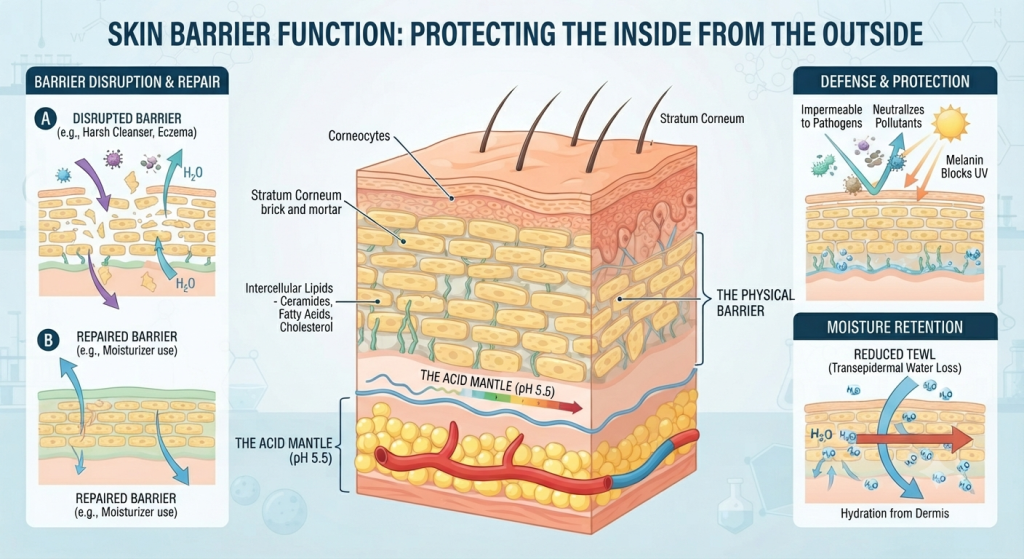
The skin barrier operates via a “brick-and-mortar” structure where skin cells (corneocytes) act as bricks and intercellular lipids (ceramides, cholesterol, and fatty acids) act as mortar. This structure keeps moisture locked inside the body while keeping environmental irritants, pollutants, and bacteria out.
Detailed Explanation
To visualize skin health, look at the microscopic structure of the epidermis. When the lipid mortar is intact, the skin appears plump, smooth, and resilient. If the mortar washes away due to harsh cleansers or environmental stress, moisture escapes through Transepidermal Water Loss (TEWL). This leaves the skin vulnerable to microscopic cracks, leading to redness, flaking, and inflammation.
1.Lipid Production:Daily Maintenance.
The lamellar bodies in the epidermis release essential lipids (ceramides, cholesterol, and free fatty acids) into the extracellular space to form a cohesive, waterproof sheet.
2.Acidification:Continuous Regulation.
Sebaceous glands secrete sebum, which mixes with sweat and lactic acid to maintain an optimal acidic surface pH of approximately 5.5, keeping harmful pathogens at bay.
3.Desquamation:28-Day Cycle.
Enzymes break down the cellular bonds (desmosomes) holding dead skin cells together, allowing them to shed cleanly from the surface without leaving a dull buildup.

Key Benefits of Structured Skin Education
Targeted Ingredient Selection: You learn exactly which active ingredients address specific concerns, such as using salicylic acid for clogged pores or niacinamide for barrier repair.
Optimized Financial Spending: By understanding what your skin actually needs, you avoid purchasing redundant products or overly expensive luxury creams with basic formulas.
Accelerated Barrier Healing: Knowing the signs of skin irritation allows you to pivot your routine quickly to soothing, humectant-rich products before severe inflammation takes hold.
Challenges and Common Skincare Mistakes
Over-Exfoliation
Problem: Chronic redness, a stinging sensation when applying basic moisturizers, and a shiny but tight skin texture.
Cause: Using multiple chemical acids (AHAs/BHAs) alongside physical scrubs or retinoids simultaneously, striping away the protective stratum corneum.
Solution: Cease all active ingredients for 14 days. Limit your routine to a gentle, non-foaming cleanser, a ceramide-rich moisturizer, and a mineral sunscreen until healing occurs.
Stripping Cleansers
Problem: Skin feels uncomfortably tight immediately after washing, followed by excessive oil production a few hours later.
Cause: Using high-pH, soap-based foaming cleansers that remove the skin’s natural lipid oils along with surface dirt.
Solution: Switch to a sulfate-free, pH-balanced gel or cream cleanser that cleanses effectively without disrupting the delicate acid mantle.
Best Practices and Expert Skin Tips
Know your actual skin type by washing your face with a gentle cleanser and waiting an hour without applying product to see if oil or dryness develops.
Apply your skincare products from thinnest to thickest consistency to ensure optimal absorption of water-based serums before sealing them with heavy oils.
Never skip daily broad-spectrum sunscreen, as ultraviolet radiation accounts for roughly 80% of visible premature skin aging.
Introduce only one new product at a time into your regimen, waiting at least two weeks before adding another to monitor for adverse reactions.
Keep your skin hydration balanced by applying humectants like hyaluronic acid or glycerin to damp skin to lock in maximum moisture.
Avoid using vitamin C and retinol in the same application window; use vitamin C in the morning for antioxidant protection and retinol at night.
Pat your skin dry with a clean microfiber towel instead of rubbing it roughly, which can cause micro-tears and worsen irritation.
Focus heavily on barrier repair ingredients like fatty acids, cholesterol, and centella asiatica if your skin feels chronically sensitive.
Comparing Skin Care Approaches
| Attribute | Symptom-Based Care | Education-Backed Care |
| Primary Goal | Masking immediate surface issues | Fixing root cosmetic and barrier causes |
| Product Selection | Driven by social media trends and scent | Driven by ingredient profiles and pH levels |
| Routine Consistency | High product turnover, frequent changes | Stable, streamlined, and highly functional |
| Long-Term Outcomes | Potential chronic irritation or stalling | Predictable, sustained skin health improvement |

Frequently Asked Questions (FAQ)
What is the difference between dry and dehydrated skin?
Direct Answer: Dry skin is a genetic skin type characterized by a lack of natural oil production in the sebaceous glands. Dehydated skin is a temporary condition characterized by a lack of water content in the stratum corneum, which can affect any skin type.
Detailed Explanation: Because dry skin lacks oil, it requires rich emollients and plant oils to rebuild its surface structure. Dehydrated skin, however, is often caused by lifestyle factors, weather, or harsh products, and needs water-binding humectants like glycerin or hyaluronic acid to restore internal hydration levels.
How long does it take to see results from a new skincare routine?
Direct Answer: It typically takes 4 to 6 weeks to notice visible changes from a new routine, as this timeline aligns with the skin’s natural cellular turnover cycle. Deep structural issues like hyperpigmentation may take up to 12 weeks.
Detailed Explanation: While humectants can plump the skin with moisture almost instantly, active ingredients designed to alter cellular behavior—such as retinoids or collagen-supporting peptides—require multiple cellular turnover cycles to reveal true, structural improvements on the surface layer.
Why does skin break out when introducing active ingredients?
Direct Answer: This phenomenon, known as skin purging, occurs when active ingredients accelerate cellular turnover, forcing preexisting microcomedones (clogged pores) to the surface all at once. It should subside within four to six weeks.
Detailed Explanation: True purging only occurs with ingredients that speed up skin cell renewal, such as alpha-hydroxy acids, beta-hydroxy acids, and retinoids. If a basic hydrating serum or oil causes breakouts, it is a standard adverse reaction or pore-clogging event, not purging.
Is a high price point an indicator of better product efficacy?
Direct Answer: No, price does not dictate product efficacy. A product’s performance relies entirely on its active ingredient concentrations, formula stability, pH levels, and delivery systems, rather than luxury packaging or branding.
Detailed Explanation: Many affordable formulations utilize identical, clinically proven ingredients sourced from the same global chemical suppliers as luxury brands. Premium pricing usually covers custom fragrances, heavy glass components, marketing campaigns, and brand positioning rather than superior skincare science.
Can lifestyle choices impact my skin barrier health?
Direct Answer: Yes, lifestyle choices significantly alter skin health. Chronic psychological stress, insufficient sleep, smoking, and diets high in refined sugars can elevate cortisol production, which degrades collagen and accelerates inflammatory skin conditions.
Detailed Explanation: Elevated cortisol levels impair the skin’s natural lipid synthesis, making the barrier more susceptible to damage. Additionally, poor sleep reduces the nocturnal growth hormone surge needed for cellular repair, leading to a duller complexion and slower healing times.
What does a compromised skin barrier feel like?
Direct Answer: A compromised barrier typically feels uncomfortably tight, itchy, dry, and hyper-sensitive. Products that usually feel soothing might cause a burning sensation, and the skin may develop rough flaking patches or sudden redness.
Detailed Explanation: When the lipid matrix is disrupted, moisture leaves rapidly while external irritants enter easily. This triggers an inflammatory response in the lower layers of the epidermis, creating a cycle of sensitivity that can only be resolved by stopping active ingredients and focusing on hydration.
Why is the pH level of skincare products important?
Direct Answer: Skin products must align with the natural, slightly acidic pH of the skin barrier (around 4.5–5.5) to keep the acid mantle intact, preserve beneficial microflora, and ensure optimal enzyme function for natural exfoliation.
Detailed Explanation: Alkaline products, such as traditional bar soaps with a pH of 9 or higher, swell the stratum corneum and dissolve critical barrier lipids. This disruption strips away protective flora, creating an environment where acne-causing bacteria can thrive.
How often should someone realistically exfoliate?
Direct Answer: Most skin types benefit from gentle chemical exfoliation two to three times per week. Over-exfoliating daily removes healthy skin cells prematurely, leading to barrier degradation, inflammation, and chronic dehydration.
Detailed Explanation: The ideal frequency depends on your skin type and the strength of the exfoliant. Oily skin types using mild salicylic acid might tolerate more frequent use, whereas sensitive or naturally dry skin types rarely need exfoliation more than once a week.
Key Takeaways
Prioritize the Barrier: A healthy skin barrier is the foundation of clear skin; never compromise it for fast cosmetic results.
Evaluate the Ingredients: Look past front-label claims and analyze the actual ingredient deck to determine product suitability.
Maintain Product Consistency: Give new skincare products at least a month to work in alignment with your natural cellular turnover.
Keep it Simple: A basic, well-formulated routine consisting of a gentle cleanser, a reliable moisturizer, and a daily sunscreen outperforms a complex ten-step routine.
Final Verdict
Navigating the vast world of skincare becomes straightforward once you invest in foundational skin education. By viewing your skin through a lens of biological science rather than marketing trends, you can construct a minimalist, effective routine that supports your skin’s natural functions. Listen to your skin’s signals, respect its delicate barrier, and focus on consistent, protective care for long-term health.