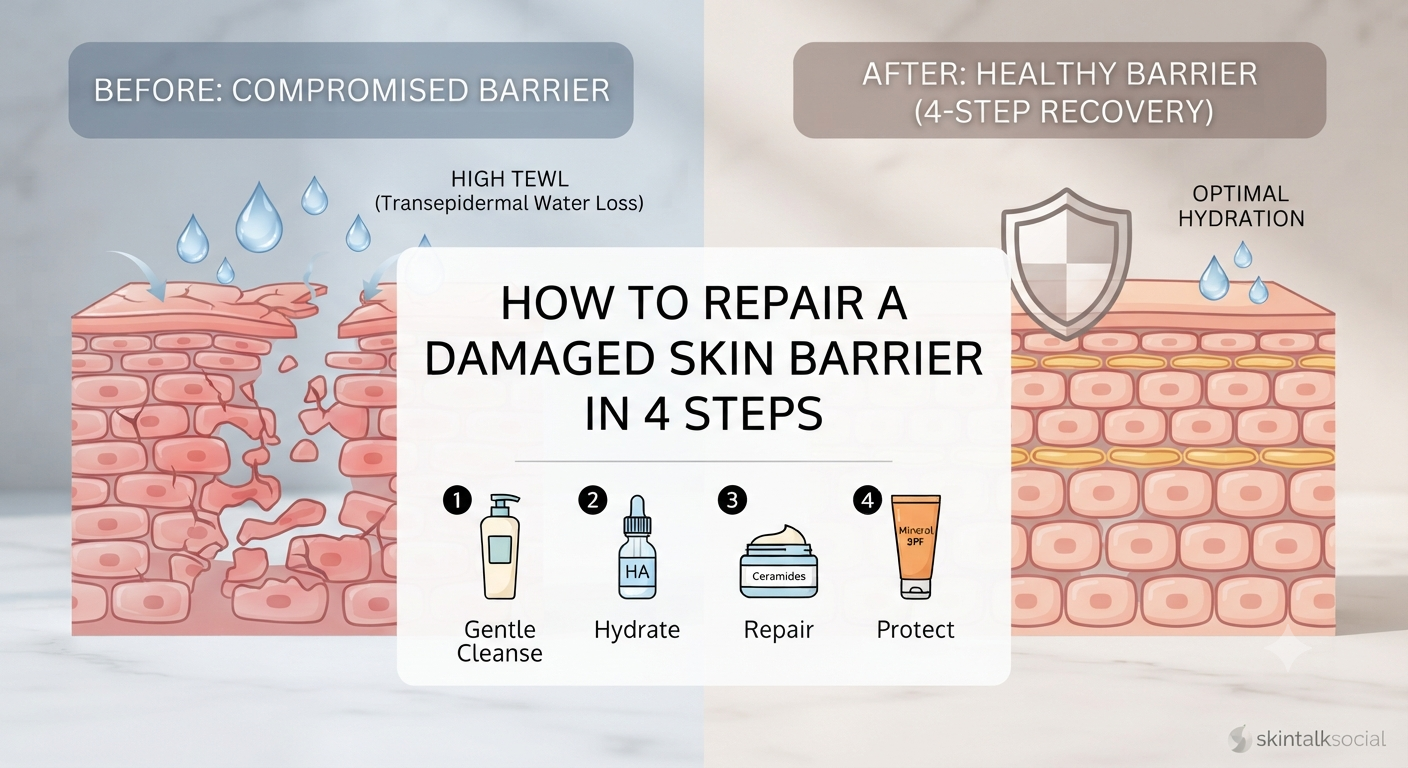
How to Repair a Damaged Skin Barrier in 4 Strict Steps
Imagine waking up, applying a gentle moisturizer you’ve used for months, and suddenly feeling an intense, burning sting. Your face is uncomfortably tight, flaky yet oddly greasy, and flushed with a persistent redness that makeup can’t seem to hide.
If this sounds familiar, you aren’t dealing with a sudden breakout or a random allergy. Your skin is crying for help. You have a damaged skin barrier.
In an era of 10-step routines, hyper-potent chemical peels, and viral social media trends convincing us to layer three different acids every single night, over-exfoliation has become a modern skincare epidemic. We have traded basic skin health for an obsession with the “perfect glow,” and our skin is paying the price.
This comprehensive guide will break down the exact science of your stratum corneum, help you identify damaged skin barrier symptoms, and provide a strict, clinical 4-step routine to nurse your skin back to optimal health.
Part 1: What Exactly is Your Skin Barrier? (The Brick & Mortar Analogy)
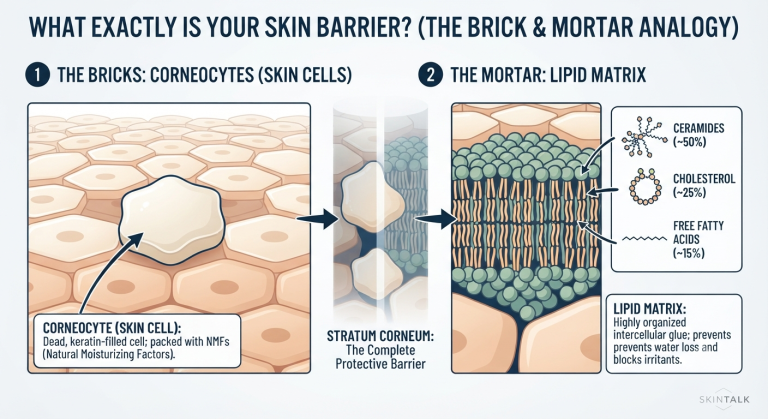
To know how to fix your skin barrier, you first have to understand what it actually is.
The outer layer of your skin is called the stratum corneum. In dermatology, this is frequently explained using the classic Brick and Mortar Analogy:
The Bricks: Your skin cells (corneocytes). These are dead skin cells packed tightly together, filled with keratin and natural moisturizing factors (NMF).
The Mortar: The intercellular lipid matrix. This is a highly organized lipid glue made up of exactly three crucial components: Ceramides (~50%), Cholesterol (~25%), and Free Fatty Acids (~15%).
+——————————————————-+
| THE SKIN BARRIER MATRIX |
+——————————————————-+
| [ BRICK ] <— Corneocyte (Skin Cell) |
| [=========] |
| [ MORTAR ] <— Lipids (50% Ceramides, 25% Choles.) |
| [=========] |
| [ BRICK ] |
+——————————————————-+
When this matrix is perfectly balanced, it performs two critical survival functions:
It keeps the good stuff in: It prevents Transepidermal Water Loss (TEWL), ensuring your deep skin layers stay plump and hydrated.
It keeps the bad stuff out: It acts as an impenetrable shield against environmental pollutants, harsh bacteria, allergens, and irritants.
When you strip away the lipid “mortar,” moisture rapidly evaporates out of your skin, and environmental irritants easily slip in. The result? Total cellular chaos
Part 2: The Red Flags — Damaged Skin Barrier Symptoms
How do you know if your skin is just purging, dry, or truly damaged? A damaged skin barrier presents a distinct cluster of clinical symptoms. Look out for these major red flags:
1. The “Product Burn”
If products that normally feel soothing (like a basic hyaluronic acid serum or a plain daily lotion) suddenly cause an intense stinging or burning sensation upon application, your barrier is compromised. The protective shield is gone, allowing product ingredients to reach raw nerve endings.
2. Dehydrated Yet Greasy Skin
This is a classic sign of high TEWL. Because your skin is rapidly losing its water content to the air, your sebaceous glands go into overdrive, pumping out excess sebum (oil) to try and seal the surface. You end up with skin that feels tight, dry, and parched underneath, but shiny and greasy on top.
3. Persistent Redness and Rough Texture
Without lipids to keep the surface smooth, dead skin cells desquamate (shed) unevenly. This leads to rough patches, flaking, micro-cracks, and localized inflammation that manifests as chronic redness or flushing.
4. Sudden, Unexplained Breakouts
If your barrier is damaged, you must immediately stop all active ingredients. This means pausing your Retinol, Vitamin C, AHA/BHA chemical peels, benzoyl peroxide, and physical scrubs.
For the next 14 to 28 days (the average time it takes for skin cells to regenerate), you are going on a strict, minimalist skincare diet.
Here is the blueprint visual to guide your recovery sequence:
See the visual breakdown in watermarked_img_9940144764694829255.png to map out your routine phase and contrast a healthy matrix against a compromised one.
Step 1: Cleanse (The Ultra-Gentle Non-Foaming Cleanse)
Your goal here is to remove dirt and sweat without removing a single lipid.
The Rule: Switch to a sulfate-free, non-foaming, creamy, or milky cleanser. Look for ingredients like Colloidal Oat, Green Tea, or Glycerin.
The Method: Wash your face with lukewarm water only—never hot. Use your fingertips gently; do not use washcloths or silicone scrubbers. If your skin is incredibly dry, you can even skip the cleanser in the morning and just rinse with cool water.
Step 2: Hydrate (Flood the Skin with Water)
Since your skin is losing water rapidly through TEWL, you need to manually bind water back into the stratum corneum.
The Rule: Apply a hydrating, alcohol-free toner or serum while your face is still slightly damp.
The Ingredients: Look for pure Hyaluronic Acid, Glycerin, Panthenol (Vitamin B5), or Centella Asiatica (Cica) to soothe inflammation. Avoid formulas with added fragrance or essential oils, which will aggravate raw skin.
Step 3: Repair (The Bio-Identical Lipid Cream)
This is the most crucial step. You cannot just use any regular lotion; you need a dedicated barrier repair cream that mimics your skin’s natural architecture.
The Rule: Find a thick, emollient cream formulated with a 3:1:1 ratio of Ceramides, Cholesterol, and Fatty Acids.
The Ingredients: Look closely at the label for Ceramide NP, Ceramide AP, Ceramide EOP, Squalane, and Shea Butter. These bio-identical ingredients literally slot into the empty spaces of your broken lipid matrix, sealing the leaks like biological spackle.
Step 4: Protect (Physical, Non-Irritating Sunscreen)
UV radiation triggers a cascade of free radicals that degrades collagen and damages cellular recovery. Healing skin must be protected from the sun.
The Rule: Use a 100% mineral (physical) sunscreen with an SPF of 30 or higher every single morning.
The Reason: Chemical sunscreen filters (like avobenzone or oxybenzone) convert UV rays into heat within the skin, which can cause stinging on a broken barrier. Mineral filters like Zinc Oxide and Titanium Dioxide sit safely on top of the skin, reflecting UV rays away. Bonus: Zinc oxide is highly anti-inflammatory and naturally calms redness.
Summary Checklist for Barrier Recovery
| Step | Action | Key Ingredient Examples | What to Avoid |
| 1. Cleanse | Creamy, non-foaming wash | Colloidal Oat, Glycerin | Sulfates, Salicylic Acid, Scrubs |
| 2. Hydrate | Damp-skin hydration layers | Hyaluronic Acid, Centella (Cica) | Denatured Alcohol, Fragrance |
| 3. Repair | Ceramide-dominant emollient | Ceramide NP/AP, Squalane, Fatty Acids | Light gels, heavy essential oils |
| 4. Protect | Physical/Mineral SPF | Zinc Oxide, Titanium Dioxide | Chemical UV filters |